


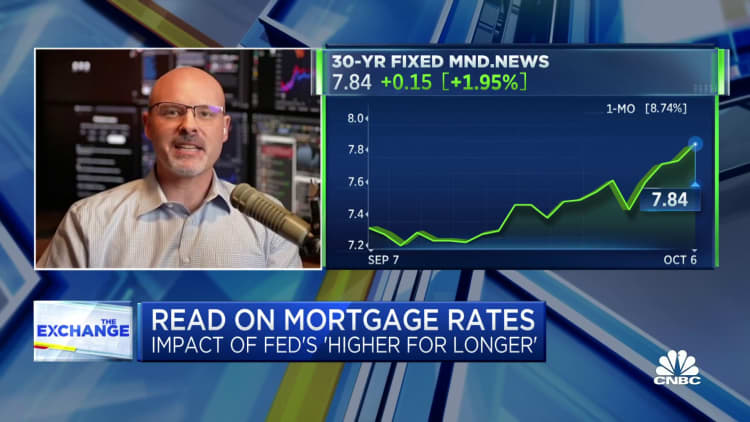
As mortgage rates reached a 23-year high last week, the cry went off across markets and social media: Is housing affordability dead? Has a version of the American dream — home ownership, kids, backyard barbecues — died with it?
The question is sharp because housing affordability has dropped by nearly half since the ultra-low interest rate days of 2021, according to the National Association of Realtors.
The median family was already $9,000 short in August of the income needed to buy the median existing home, the association says, and the recent surge in rates since has moved another five million U.S. families below the qualification standard for a $400,000 loan, according to John Burns Real Estate Consulting. At 3% mortgage rates, 50 million households could get a loan that size. Now it’s 22 million.
While an easing in treasury bond yields this week has brought the 30-year fixed mortgage back a shade below 8%, there is no quick fix.
The qualifying yearly income for a median-priced house in 2020 was $49,680. Now it’s more than $107,000, according to the NAR. Redfin puts the figure at $114,627.
″[These are] stunning numbers that render house affordability even more challenging for too many American families, especially those looking to buy their first home,” bond-market maven Mohamed El-Erian, an advisor to Allianz among many other roles, posted on X.
“It’s a very worrisome development for America,” NAR chief economist Lawrence Yun said.
Affordability depends on three big numbers, according to Yun — family income, the price of the house, and the mortgage rate. With incomes rising since 2019, the bigger issue is interest rates. When they were low, they papered over a surge in housing prices that began in late 2020, helped by people relocating to areas like Florida, Austin, Texas, and Boise, Idaho, to work in their old cities from their new homes. Now, the surge in rates is crushing affordability even as incomes rise sharply and housing prices mostly hang on to the big gains they generated during Covid.
“At the current 8% mortgage rate, mortgage payment[s] are 38% of median income,” Moody’s Analytics chief economist Mark Zandi said. “The mortgage rate has to fall to 5.5%, or the median priced home has to fall by 22%, or the median income has to increase by 28%, or some combination of all three variables.”
At the same time, demand for adjustable-rate mortgages has spiked to its highest level in a year amid the broader slowdown in mortgage applications.
What needs to change to make housing affordable again
All three indicators face a tough road back to “normal,” and normal is a long way from here. A few numbers illustrate why.
The National Association of Realtors measures affordability through its 34-year old Housing Affordability Index, or HAI. It calculates how much income the median family has to have to afford the median existing home, which, right now, costs about $413,000, according to NAR. If the index equals 100, it means the median family has enough income to buy that house with a 20% down payment. The index assumes the family wants to pay 25% of its income toward principal and interest.
The long-term average of the HAI is 138.1, meaning that, normally, the median family has a 38% cushion. Its all-time high was 213 in 2013, after the housing bust and 2008 financial crisis.
Right now, that index stands at 88.7.
A few scenarios using NAR data help illustrate how far affordability is from the average between 1989 and 2019, and what would be required to push it back into a more typical range as the national average for the 30-year ticked lower to 7.98% on Tuesday.
- If home prices are stable, rates need to fall to 3.55% in order to be back to historical average.
- If prices grow 5%, rates need to fall to 3.16%.
- If prices stay the same but incomes increase 5%, rates need to fall to 3.95%
- A mortgage rate that stays around 8% means median home prices need to fall by 35%, to $265,000.
- If rates stay at 8% and prices at current levels, income needs to increase by 63%.
But these numbers understate the challenge of getting affordability back to where Americans are used to seeing it.
Getting back to the affordability people enjoyed during the hyper-low interest rates of the pandemic would take even more: The HAI reached a yearly average of 169.9 that year, a level few think will come back any time soon.
Affordability became stretched partly because home prices rose 38% since 2020, according to the NAR, but more important was the jump in average interest rates from 3% in 2021 to as high as 8% last week. That’s a 167% jump, driving a $1,199 increase in monthly payments on a newly bought house, per NAR.
Higher wages are a plus, but not enough
Rising incomes will help, and median family incomes have climbed 16% to more than $98,000 since 2020. But that isn’t nearly enough to cover the affordability gap without devoting a higher share of the household paychecks to the mortgage, said Zandi.
Aside from the raw numbers, the direction of monetary policy will keep incomes from fixing the housing problem, said Doug Duncan, chief economist at Fannie Mae. The Federal Reserve has been raising interest rates precisely because it thinks wages have been growing fast enough to reinforce post-Covid inflation, Duncan said. Year-over-year wage gains slipped to 3.4% in the most recent job-market data, he said, and the Fed would like wage growth to be lower.
Downward pressure on home prices would help, but it does not look like they will decline by much. And even if home prices do the decline, that trend won’t be sustainable unless America builds millions of more homes.
After prices surged from 2019 through early 2022, it was easy to assume a big price correction coming, but it hasn’t happened. In most markets, prices have even begun to turn up a little bit. According to the realtors’ association, the median price of an existing home dropped by more than $35,000 in late 2022 but has risen by $45,000 since its low in January.
Not enough new housing in America
The biggest reason is that so few homes are up for sale that the laws of supply and demand aren’t working normally. Even with demand hit by affordability woes, buyers who are out there have to compete for so few homes that prices have stayed close to balanced.
“Boomers are doing what they said they were going to do. They are aging in place,” Duncan said. “And Gen X is locked into 3% mortgages already. So it’s up to the builders.”
The builders are kind of a problem, said Redfin chief economist Daryl Fairweather. They’ve been boosting profits this year, and BlackRock’s exchange traded fund

 Northwest Arkansas Board of REALTORS® All information deemed reliable but not guaranteed. All properties are subject to prior sale, change or withdrawal. Neither listing broker(s) or information provider(s) shall be responsible for any typographical errors, misinformation, misprints and shall be held totally harmless. Listing(s) information is provided for consumer's personal, non-commercial use and may not be used for any purpose other than to identify prospective properties consumers may be
